What Does Analysis Mean in Art Greek Column Order Meaning

Two early Archaic Doric order Greek temples at Paestum (Italia) with much wider capitals than later

The Doric lodge was one of the three orders of ancient Greek and later Roman architecture; the other two approved orders were the Ionic and the Corinthian. The Doric is most easily recognized by the simple circular capitals at the top of columns. Originating in the western Doric region of Greece, it is the earliest and, in its essence, the simplest of the orders, though still with complex details in the entablature higher up.
The Greek Doric cavalcade was fluted or smooth-surfaced,[1] and had no base of operations, dropping direct into the stylobate or platform on which the temple or other edifice stood. The capital was a uncomplicated circular form, with some mouldings, nether a square cushion that is very wide in early on versions, but later on more restrained. In a higher place a plain architrave, the complexity comes in the frieze, where the ii features originally unique to the Doric, the triglyph and guttae, are skeuomorphic memories of the beams and retaining pegs of the wooden constructions that preceded stone Doric temples.[2] In rock they are purely ornamental. The relatively uncommon Roman and Renaissance Doric retained these, and oftentimes introduced thin layers of moulding or further decoration, as well as often using manifestly columns. More often they used versions of the Tuscan club, elaborated for nationalistic reasons past Italian Renaissance writers, which is in issue a simplified Doric, with un-fluted columns and a simpler entablature with no triglyphs or guttae. The Doric gild was much used in Greek Revival architecture from the 18th century onwards; often before Greek versions were used, with wider columns and no bases to them.
The ancient builder and architectural historian Vitruvius assembly the Doric with masculine proportions (the Ionic representing the feminine).[3] [4] It is too normally the cheapest of the orders to utilise. When the three orders are superposed, information technology is usual for the Doric to exist at the bottom, with the Ionic and so the Corinthian above, and the Doric, as "strongest", is often used on the footing floor below another society in the storey in a higher place.[5]
History [edit]
Greek [edit]

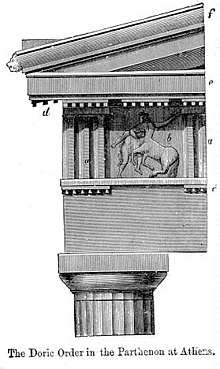
In their original Greek version, Doric columns stood direct on the flat pavement (the stylobate) of a temple without a base. With a height only four to viii times their bore, the columns were the most squat of all the classical orders; their vertical shafts were fluted with 20 parallel concave grooves chosen arrises; and they were topped by a smoothen upper-case letter that flared from the cavalcade to run across a square abacus at the intersection with the horizontal beam (architrave) that they carried. The Parthenon has the Doric design columns. It was near popular in the Primitive Menses (750–480 BC) in mainland Greece, and likewise institute in Magna Graecia (southern Italy), as in the three temples at Paestum. These are in the Archaic Doric, where the capitals spread wide from the column compared to later Classical forms, as exemplified in the Parthenon.
Pronounced features of both Greek and Roman versions of the Doric order are the alternating triglyphs and metopes. The triglyphs are decoratively grooved with ii vertical grooves ("tri-glyph") and represent the original wooden cease-beams, which rest on the patently architrave that occupies the lower one-half of the entablature. Nether each triglyph are peglike "stagons" or "guttae" (literally: drops) that appear as if they were hammered in from below to stabilize the mail service-and-beam (trabeated) construction. They as well served to "organize" rainwater runoff from to a higher place. The spaces between the triglyphs are the "metopes". They may be left plain, or they may be carved in low relief.[half-dozen]
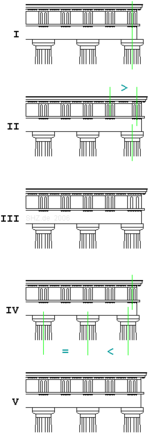
The Doric corner conflict
Spacing the triglyphs [edit]
The spacing of the triglyphs caused problems which took some fourth dimension to resolve. A triglyph is centered above every cavalcade, with some other (or sometimes 2) betwixt columns, though the Greeks felt that the corner triglyph should form the corner of the entablature, creating an inharmonious mismatch with the supporting column.
The compages followed rules of harmony. Since the original blueprint probably came from wooden temples and the triglyphs were real heads of wooden beams, every column had to comport a beam which lay across the middle of the column. Triglyphs were arranged regularly; the last triglyph was centred upon the last column (illustration, right: I. ). This was regarded as the platonic solution which had to be reached.
Changing to stone cubes instead of wooden beams required full support of the architrave load at the last column. At the first temples the final triglyph was moved (analogy, right: Two. ), however terminating the sequence, only leaving a gap agonizing the regular order. Even worse, the last triglyph was non centered with the respective column. That "archaic" fashion was not regarded equally a harmonious design. The resulting trouble is chosen the doric corner conflict. Some other approach was to employ a broader corner triglyph ( III. ) but was not really satisfying.
Because the metopes are somewhat flexible in their proportions, the modular space between columns ("intercolumniation") can be adjusted by the architect. Often the concluding two columns were gear up slightly closer together (corner contraction), to give a subtle visual strengthening to the corners. That is called the "classic" solution of the corner conflict ( 4. ). Triglyphs could be arranged in a harmonic manner again, and the corner was terminated with a triglyph, though the final triglyph and column were often not centered. Roman aesthetics did not need that a triglyph grade the corner, and filled information technology with a half (demi-) metope, allowing triglyphs centered over columns (analogy, right, V. ).
Temples [edit]
At that place are many theories as to the origins of the Doric gild in temples. The term Doric is believed to have originated from the Greek-speaking Dorian tribes.[7] 1 belief is that the Doric social club is the result of early forest prototypes of previous temples.[8] With no difficult proof and the sudden appearance of rock temples from ane catamenia after the other, this becomes mostly speculation. Another belief is that the Doric was inspired by the architecture of Egypt.[ix] With the Greeks being present in Ancient Egypt equally soon the 7th-century BC, it is possible that Greek traders were inspired past the structures they saw in what they would consider foreign land. Finally, another theory states that the inspiration for the Doric came from Mycenae. At the ruins of this civilization lies compages very similar to the Doric guild. It is also in Greece, which would make information technology very accessible.


Some of the earliest examples of the Doric order come from the seventh-century BC. These examples include the Temple of Apollo at Corinth and the Temple of Zeus at Nemea.[10] Other examples of the Doric order include the 6th-century BC temples at Paestum in southern Italy, a region called Magna Graecia, which was settled past Greek colonists. Compared to afterward versions, the columns are much more massive, with a strong entasis or swelling, and wider capitals.
The Temple of the Delians is a "peripteral" Doric lodge temple, the largest of three dedicated to Apollo on the island of Delos. It was begun in 478 BC and never completely finished. During their period of independence from Athens, the Delians reassigned the temple to the island of Poros. Information technology is "hexastyle", with half-dozen columns across the pedimented end and 13 along each long face. All the columns are centered under a triglyph in the frieze, except for the corner columns. The plain, unfluted shafts on the columns stand straight on the platform (the stylobate), without bases. The recessed "necking" in the nature of fluting at the top of the shafts and the wide cushionlike echinus may be interpreted as slightly self-conscious archaising features, for Delos is Apollo's ancient birthplace. Even so, the similar fluting at the base of the shafts might point an intention for the evidently shafts to be capable of wrapping in mantle.
A classic statement of the Greek Doric social club is the Temple of Hephaestus in Athens, built about 447 BC. The contemporary Parthenon, the largest temple in classical Athens, is also in the Doric order, although the sculptural enrichment is more familiar in the Ionic club: the Greeks were never every bit doctrinaire in the apply of the Classical vocabulary equally Renaissance theorists or Neoclassical architects. The detail, office of the bones vocabulary of trained architects from the later on 18th century onwards, shows how the width of the metopes was flexible: here they deport the famous sculptures including the boxing of Lapiths and Centaurs.
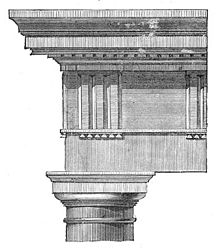
Roman [edit]
In the Roman Doric version, the peak of the entablature has been reduced. The endmost triglyph is centered over the column rather than occupying the corner of the architrave. The columns are slightly less robust in their proportions. Below their caps, an astragal molding encircles the column similar a band. Crown moldings soften transitions between frieze and cornice and emphasize the upper edge of the abacus, which is the upper part of the majuscule. Roman Doric columns too have moldings at their bases and stand on low square pads or are even raised on plinths. In the Roman Doric fashion, columns are not invariably fluted. Since the Romans did not insist on a triglyph covered corner, now both columns and triglyphs could be arranged equidistantly once again and centered together. The architrave corner needed to be left "blank," which is sometimes referred to every bit a half, or demi-, metope (illustration, Five., in Spacing the Columns higher up).
The Roman architect Vitruvius, following contemporary exercise, outlined in his treatise the process for laying out constructions based on a module, which he took to be one half a cavalcade's diameter, taken at the base. An illustration of Andrea Palladio's Doric order, as information technology was laid out, with modules identified, by Isaac Ware, in The Four Books of Palladio's Architecture (London, 1738) is illustrated at Vitruvian module.
According to Vitruvius, the height of Doric columns is half-dozen or seven times the diameter at the base of operations.[11] This gives the Doric columns a shorter, thicker look than Ionic columns, which have 8:1 proportions. It is suggested that these proportions requite the Doric columns a masculine appearance, whereas the more slender Ionic columns appear to stand for a more feminine look. This sense of masculinity and femininity was often used to determine which blazon of column would be used for a particular structure.
The nearly influential, and perhaps the earliest, utilize of the Doric in Renaissance compages was in the circular Tempietto past Donato Bramante (1502 or afterward), in the courtyard of San Pietro in Montorio, Rome.[12]
Graphics of ancient forms [edit]
-
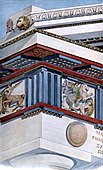
Original Doric polychromy
-
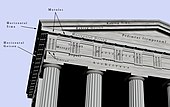
Upper parts, labelled
-
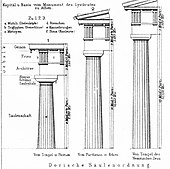
Three Greek Doric columns
Modern [edit]

Before Greek Revival architecture grew, initially in England, in the 18th century, the Greek or elaborated Roman Doric order had not been very widely used, though "Tuscan" types of circular capitals were e'er popular, specially in less formal buildings. It was sometimes used in armed forces contexts, for example the Royal Hospital Chelsea (1682 onwards, past Christopher Wren). The first engraved illustrations of the Greek Doric guild dated to the mid-18th century. Its appearance in the new phase of Classicism brought with it new connotations of high-minded primitive simplicity, seriousness of purpose, noble sobriety.
In Germany information technology suggested a contrast with the French, and in the United States republican virtues. In a customs house, Greek Doric suggested incorruptibility; in a Protestant church a Greek Doric porch promised a render to an untainted early church; it was every bit appropriate for a library, a bank or a trustworthy public utility. The revived Doric did not render to Sicily until 1789, when a French architect researching the ancient Greek temples designed an entrance to the Botanical Gardens in Palermo.
Examples [edit]
- Aboriginal Greek, Archaic
- Temple of Artemis, Corfu, the earliest known stone Doric temple
- Temple of Hera, Olympia
- Delphi, temple of Apollo
- The 3 temples at Paestum, Italia
- Valle dei Templi, Agrigento, Temple of Juno, Agrigento and others
- Temple of Aphaea
- Ancient Greek, Classical
- Temple of Zeus, Olympia
- Temple of Hephaestus
- Bassae, Temple of Apollo
- Parthenon, Athens
- Sounion, Temple of Poseidon
- Renaissance and Bizarre
- The Tempietto by Donato Bramante, in the courtyard of San Pietro in Montorio, Rome
- Palace of Charles Five, Granada, 1527, circular arcade in the courtyard, under Ionic in the upper storey
- Basilica Palladiana, in Vicenza, Andrea Palladio, 1546 on, arcade under Ionic to a higher place
- Valladolid Cathedral, Juan de Herrera, begun 1589
- Neoclassical and Greek Revival
- Brandenburg Gate, Berlin, 1788
- The Grange, Northington, 1804
- Lord Hill'southward Cavalcade, Shrewsbury, England, 1814, 133 feet six inches (40.69 m) high
- Neue Wache, Berlin, 1816
- Imperial High School, Edinburgh, completed 1829
- Walhalla, Regensburg, Bavaria, 1842
- Propylaea, Munich, 1854
- U.s.
- Second Bank of the United States, Philadelphia, 1824
- Naval Medical Center Portsmouth, 1827, pedimented temple front with ten columns
- Perry's Victory and International Peace Memorial in Put-in-Bay, Ohio, is the earth'south tallest and almost massive Doric column at 352 feet (107 chiliad).
- Harding Tomb in Marion, Ohio, is a round Greek temple blueprint with Doric columns.
Gallery [edit]
-

Temple of Athena, Assos in Turkey
-

Engraving of a Doric entablature from Speculum Romanae Magnificentiae, 1536, in the Metropolitan Museum of Art
-

Engraving of a Doric majuscule from Speculum Romanae Magnificentiae, circa 1537, in the Metropolitan Museum of Art
-

Interior of the Metropolitan Museum of Art with Doric columns
-

The entrance of La Sorbonne from Paris, with a pair of Doric columns and an entablature with triglyphs and empty metopes
Run across too [edit]
- Geison
References [edit]
- ^ Art a Cursory History sixth Edition
- ^ Summerson, thirteen–fourteen
- ^ Vitruvius. De architectura. p. 4.1. Retrieved 25 Apr 2020.
- ^ Summerson, 14–15
- ^ Palladio, Commencement Book, Affiliate 12
- ^ Summerson, 13–15, 126
- ^ Ian Jenkins, Greek Compages And Its Sculpture (Cambridge, Massachusetts: Harvard Academy Press, 2006), fifteen.
- ^ Jenkins, 16.
- ^ Jenkins, 16–17.
- ^ Robin F. Rhodes, "Early Corinthian Architecture and the Origins of the Doric Club" in the American Journal of Archaeology 91, no. three (1987), 478.
- ^ "... they measured a man's foot, and finding its length the sixth part of his height, they gave the column a similar proportion, that is, they made its height, including the majuscule, half-dozen times the thickness of the shaft, measured at the base of operations. Thus the Doric society obtained its proportion, its forcefulness, and its beauty, from the human effigy." (Vitruvius, iv.6) "The successors of these people, improving in taste, and preferring a more slender proportion, assigned 7 diameters to the height of the Doric column." (Vitruvius, iv.viii)
- ^ Summerson, 41–43
- ^ Fullerton, Mark D. (2020). Art & Archaeology of The Roman Globe. Thames & Hudson. p. 87. ISBN978-0-500-051931.
Sources [edit]
- Labeled Doric Cavalcade
- Summerson, John, The Classical Linguistic communication of Architecture, 1980 edition, Thames and Hudson World of Fine art series, ISBN 0500201773
- James Stevens Curlicue, Classical Architecture: An Introduction to Its Vocabulary and Essentials, with a Select Glossary of Terms
- Georges Gromort, The Elements of Classical Architecture
- Alexander Tzonis, Classical Architecture: The Poetics of Gild (Alexander Tzonis website)
External links [edit]
 Media related to Doric columns at Wikimedia Eatables
- Classical orders and elements
Source: https://en.wikipedia.org/wiki/Doric_order
0 Response to "What Does Analysis Mean in Art Greek Column Order Meaning"
Post a Comment